
Do you have written goals? I am asking if you have written goals rather than goals because if they are not written, they will not go beyond wishes. Forbes magazine had an article called ‘Neuroscience Explains Why You Need to Write Down Your Goals If You Actually Want to Achieve Them’. It explains in detail the importance of writing your goals.
There are hundreds of books and articles about setting goals, but still, it is not part of our lives. There are many reasons for it. First, we have not been taught what goal setting means by our teachers or parents. Second, most of us still do not believe that setting goals makes a difference in our lives, and do not even try. So, this leaves very few people who set goals and achieve them. The research results vary from study to study, which indicates the number of people who are setting and reaching their goals are less than 10%. For example, the University of Scranton’s research suggests that just 8 percent of people achieve their New Year’s goals.
I consider myself one of the lucky people who started to set goals and achieve them at an early age. I always loved writing my goals and plans, since I was a little girl. Sometimes, my elder sister would read them and made fun of me all day. Most of the time, I would feel embarrassed, because even when I was a little girl, I had big dreams and many future plans. So, these would provide enough material to my sister to tease me. I have not changed, and I keep setting weekly, monthly, and yearly goals. I achieved most of my goals eventually. I believe that writing them again and again, without getting tired helped me a lot.
If you haven’t tried yet, you can easily start applying it to your life right now. It is worth trying. The simplest way to set a goal is by writing your dreams in a notebook, on a paper or anywhere you can periodically review. The only recommendation I could give is to write truly what your heart desires.
Another way to create your list of goals is by using a method called SMART. It is an acronym of Specific, Measurable, Achievable, Relevant, and Time-Bound, which gives you brief guidance for wording your goals.
Another key point is that setting open ended goals do not take you where you want to be. For example, ‘I want to lose weight’ can be one of my goals, but if we word it by using the SMART method, we can have a clear vision and direction. So, the SMART version could be ‘I want to lose 10 pounds by July 1st, 2019’.
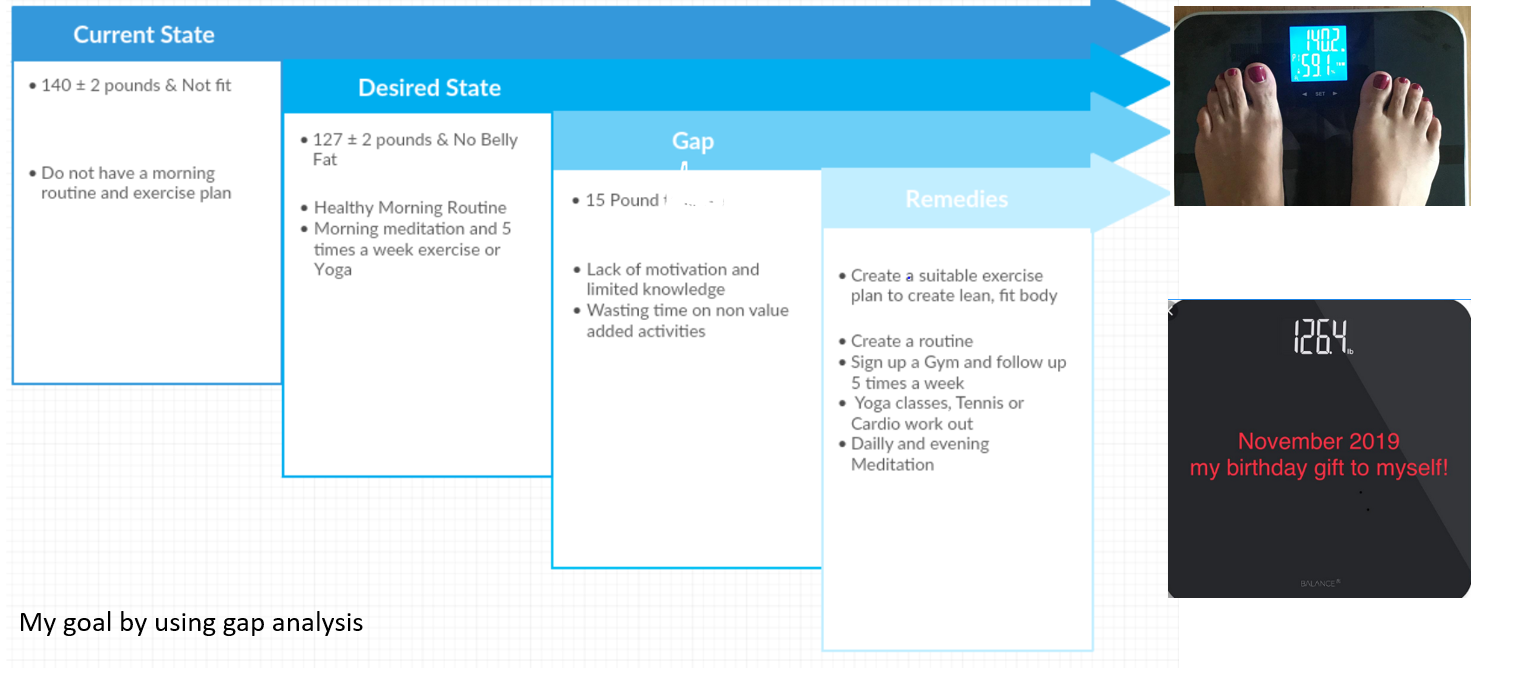
Also, I’ve just started to use a gap analysis method. Since I am an engineer, I wanted to use a method that related to my work 😊. I am hoping that will help me to achieve my goals faster. It is quite simple as well. Define your current status, dream about where you want to be, and then, take all the necessary actions that can help you to get there.
Here is the simple version of one of my recent goals, and moving forward, I can’t wait to share the results.


 I’m a Project Manager with a deep passion for both professional and personal growth. Designing and building the next generation of vehicles is incredibly rewarding, but it comes with its challenges—especially for someone as emotionally invested as I am!